

| Feature | Standard Epoxy | Colorado Springs Garage Floors (Polyaspartic) |
|---|---|---|
| Installation Time | 3-5 Days (Slow Cure) | 2 Days (48 Hour Use) |
| Durability | Brittle; Prone to Chipping | 4x Stronger & Flexible |
| UV Resistance | Yellows/Chalks in Sun | 100% UV Stable (Stays Clear) |
| Temperature Range | Must be 50°F+ to apply | All-Weather (Apply down to -20°F) |
| Chemical Resistance | Stained by Oil/Gas/Salts | Industrial Grade Protection |


What is Epoxy Coating?
Epoxy is a resin polymer that has been used on garage floors for decades. It works reasonably well in controlled indoor environments and is available in many color and flake options. It’s typically the lower-cost option upfront.
The problem is what happens next. Epoxy requires a minimum of 50°F to cure properly. It fades and yellows under UV exposure. It’s less flexible than polyaspartic, which makes it vulnerable to Colorado’s freeze-thaw cycles. And it’s porous — which creates a serious problem in a state that coats its roads with magnesium chloride all winter.
What is Polyaspartic Floor Coating?
Polyaspartic is a newer chemistry — first developed in the early 1990s as a corrosion-resistant coating for steel bridges. It outperforms epoxy in flexibility, UV stability, chemical resistance, and temperature tolerance.
Proper surface preparation is essential. Polyaspartic bonds to concrete through a chemical process verified by independent adhesion pull-off strength testing (ASTM D4541) — which is why diamond grinding before installation is non-negotiable.
Colorado Springs Garage Floors installs a true 3-coat system using Slide-Lok products exclusively across all three coats — primer, base coat with decorative flake, and a high-build topcoat. No cheaper base layers. No hybrid chemistry.


The Colorado Factor: Magnesium Chloride vs. Your Floor
In Colorado Springs and along the Front Range, roads are treated with Magnesium Chloride and liquid de-icers throughout the winter. While great for driving, these chemicals are floor killers for standard epoxy.- Porous Surface: Standard epoxy is surprisingly porous. Magnesium Chloride seeps into the coating, weakening the bond to the concrete underneath.
- Hot Tire Pickup: When you drive a warm tire onto a salt-soaked epoxy floor, the chemical reaction causes the epoxy to delaminate — right where the cars park. This is why you see epoxy floors peeling in that exact spot.
- The Brittle Freeze: Colorado’s -20°F nights make epoxy brittle, causing it to crack as the concrete expands and contracts.
🚀 The Polyaspartic Advantage: Our industrial-grade coating is 100% non-porous and chemically inert. It creates a seamless barrier that Magnesium Chloride and road salts cannot penetrate, ensuring your garage stays showroom-quality regardless of the winter weather.
The Truth About “1-Day” Floors vs. Our 3-Coat Process
You’ve probably seen ads for “1-Day Garage Floors.” Polyaspartic technology does allow for fast cure times — but there’s a significant difference between rushing a job and respecting the process.
The “1-Day” Trap
Many contractors use a 2-coat system to save on material costs and labor, then count the decorative flake layer as the third coat. The result is a thinner floor that’s more prone to wearing through over time — and a warranty that can’t back up a lifetime claim.
Our 3-Coat Standard
Colorado Springs Garage Floors installs a true 3-coat system: a deep-penetrating primer, a dedicated base coat with flake broadcast on top, and a high-build topcoat. The flake is not counted as a coat. We use Slide-Lok products exclusively across all three coats — consistent chemistry from surface to finish. Fast-curing chemistry is never a reason to rush the job: each coat goes down only when the one beneath it is ready. The chemistry, not the clock, determines when each coat goes down. That’s what backs a lifetime warranty.Epoxy vs Polyaspartic: Side-by-Side
- Durability — Epoxy is vulnerable to abrasion, cracking, and delamination. Polyaspartic is 4x more impact and abrasion resistant, maintains flexibility through temperature swings, and won’t chip, scratch, or yellow.
- UV Resistance — Epoxy fades, chalks, and yellows under prolonged UV exposure. Polyaspartic is 100% UV stable — the color and finish hold for decades.
- Temperature Range — Epoxy requires 50°F or warmer to cure. Polyaspartic installs down to -20°F, which means year-round installation is possible in Colorado.
- Drying Time — One layer of polyaspartic cures in under an hour. A single epoxy coat can take 16 hours. Our full 3-coat system is ready for vehicle traffic in 48 hours.
- Warranty — Polyaspartic installed by Colorado Springs Garage Floors carries a residential lifetime warranty. Epoxy does not.
- DIY — Epoxy can be applied DIY with a roller and more forgiving timing. Polyaspartic dries too fast for DIY application — professional installation is required to ensure proper adhesion and coverage.
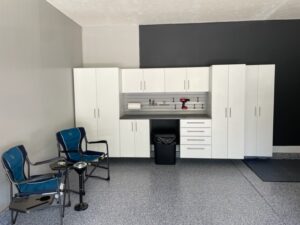
The Real Cost of Epoxy vs Polyaspartic Over Time
Most buyers compare the upfront number. That’s the wrong comparison.
Epoxy costs less on day one. But in Colorado Springs, epoxy typically fails within 3–7 years — peeling, yellowing, or delaminating from road salt damage. When that happens, the floor has to be ground down to bare concrete and recoated from scratch. That costs nearly as much as the original installation. Do that twice over 15 years, and you’ve paid for a quality polyaspartic floor twice over — while still not having one.
A 3-coat polyaspartic system costs more upfront. It also carries a residential lifetime warranty and doesn’t need to be redone.
The cheaper quote is not cheaper. It’s a shorter-term decision with a higher long-term cost.
We don’t publish pricing because every project is different — square footage, concrete condition, and color choices all affect the investment. Request a free estimate and we’ll give you an accurate number for your specific project.
Frequently Asked Questions: Epoxy vs Polyaspartic
Is polyaspartic better than epoxy for garage floors? Yes. Polyaspartic is 4x more impact and abrasion resistant than epoxy, 100% UV stable, and can be applied down to -20°F. In Colorado Springs, where road salt, freeze-thaw cycling, and high-altitude UV are constants, epoxy typically fails within 3–7 years. A properly installed 3-coat polyaspartic system is backed by a residential lifetime warranty. Why does epoxy peel in Colorado garages? Colorado roads are treated with magnesium chloride throughout winter. Standard epoxy is porous — those chemicals seep into the coating and weaken the bond to the concrete. Add hot tire pickup and freeze-thaw temperature swings and you get delamination right where the cars park. Polyaspartic is 100% non-porous and chemically inert, so road salts can’t penetrate it. How long does polyaspartic last compared to epoxy? Epoxy typically lasts 3–7 years before yellowing, peeling, or delaminating — especially in Colorado conditions. A professional 3-coat polyaspartic system from Colorado Springs Garage Floors carries a residential lifetime warranty. Can polyaspartic be applied in cold weather? Yes — down to -20°F. Epoxy requires a minimum of 50°F to cure properly, which limits installation to warmer months and creates adhesion problems if temperatures drop overnight. Polyaspartic installs year-round. What is a 3-coat polyaspartic system? A true 3-coat system is a deep-penetrating primer, a base coat with decorative flake broadcast on top, and a high-build topcoat — with the flake not counted as a coat. Many contractors use a 2-coat system and count the flake as the third coat to save on materials. Colorado Springs Garage Floors uses Slide-Lok products across all three coats for consistent chemistry and maximum adhesion. How much does polyaspartic cost compared to epoxy? Polyaspartic costs more upfront. But when epoxy lasts 3–7 years and must be ground out and recoated — and polyaspartic carries a lifetime warranty — the long-term math is clear. We provide free estimates and don’t publish price ranges because every project is different. Request yours here.Ready to Upgrade Your Colorado Garage?
Don’t settle for a floor that needs to be redone in five years. Get a residential lifetime warranty and a true 3-coat polyaspartic system built for Colorado conditions.
Serving Colorado Springs, Monument, Fountain, Falcon, Pueblo, and the surrounding Pikes Peak region.