Is Winter Road Salt Ruining Your Garage Floor? (And How We Can Help Stop It!)
Hello, neighbors! If you live here in the beautiful Pikes Peak Region, you know that our winters can be as unpredictable as they are stunning. One day it’s sunny and 60 degrees, and the next, we are digging our cars out of a foot of snow. Here at Colorado Springs Garage Floors, our family has been helping locals upgrade and protect their homes for over 16 years, and there is one question we get asked every single winter: “What is all this winter slush doing to my concrete?”
It’s a great question. While we all know to run our cars through the car wash to keep the rust away, we often don’t think about where all that corrosive, salty winter slush ends up—right on our garage floors. If you have a bare concrete floor in your garage, the winter season might quietly be causing permanent damage. The main culprit? The chemical de-icers used to keep our roads safe, specifically magnesium chloride.
In this article, Steve and the team are going to break down how these road treatments travel home with you, exactly what they do to your concrete, and why our true 3-coat polyaspartic system is the ultimate, family-friendly solution to protect your home.
The “Triple Threat” of Colorado Winter Roads
To understand what is happening to your garage floor, it helps to understand what you are driving through on your daily commute around El Paso County. Local road maintenance crews use a highly effective “triple threat” strategy to manage winter storms. While these treatments are absolutely fantastic for public safety and keeping us on the road, they are notoriously harsh on our vehicles and our driveways.
The Liquid Pre-Treatment (Magnesium Chloride): Before a major storm hits the Front Range, you will often see dark, wet-looking stripes sprayed down the highway. This is liquid magnesium chloride (often known by the brand name APEX). It acts as a powerful anti-icer, lowering the freezing point of water to prevent snow from bonding to the asphalt in the first place. It is highly effective, especially when temperatures are above 20°F.
The Granular De-Icer (IceSlicer): Once the snow starts falling heavily, crews switch to complex chlorides like IceSlicer. This reddish-white granular mix is primarily sodium chloride, but it is fortified with magnesium, potassium, and calcium. It melts ice rapidly upon contact, creating that brown slush we all know so well.
The Anti-Skid Mix (Sand and Salt): On our residential routes and side streets, a mixture of sand and salt (usually about 20% salt) is dispersed. This provides crucial mechanical traction for tires so we can safely navigate our neighborhoods.
When you drive home to Monument, Falcon, or anywhere in between after a storm, your wheel wells, undercarriage, and tires are packed with a heavy, slushy mix of water, magnesium chloride, IceSlicer, and dirt. When you pull into your garage and park, the ambient heat of your home and your vehicle’s engine causes that slush to melt.
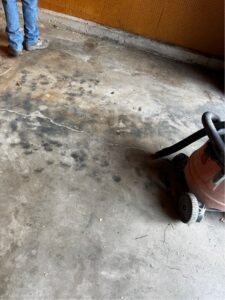
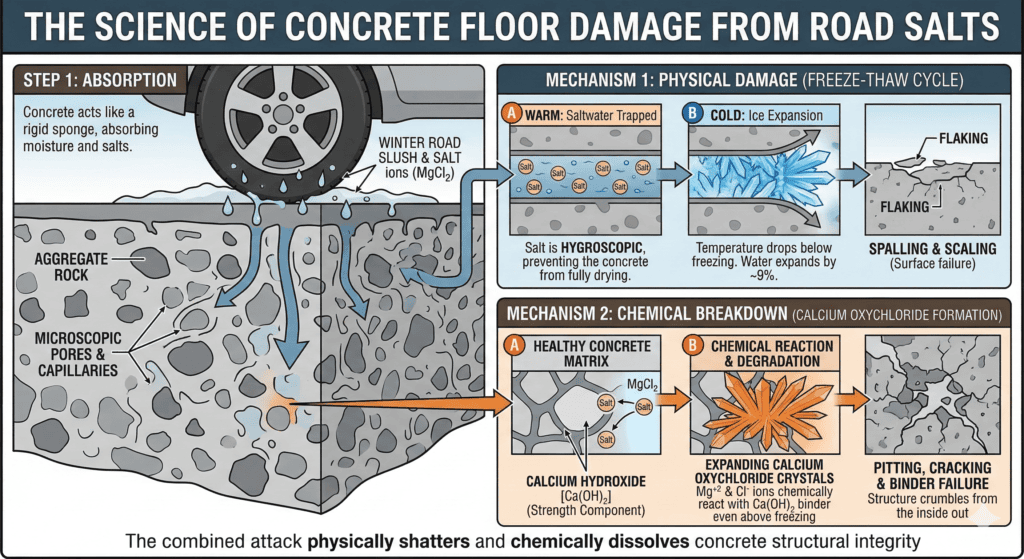
It drips off your car, forming toxic, gray, salty puddles right under your tires. If your floor is untreated concrete, this is where the unseen damage begins. Concrete looks solid, but it is actually incredibly porous. It acts like a giant, rigid sponge, constantly absorbing moisture from its environment.
The Science of the Damage: What Happens Inside Your Concrete?
When that moisture is laced with magnesium chloride and road salts, two distinct forms of destruction occur inside your concrete slab: physical and chemical.
1. The Freeze-Thaw Cycle (Physical Damage)
Because magnesium chloride is naturally hygroscopic (meaning it attracts and holds onto moisture), it prevents the puddles in your garage from fully drying out. The saltwater solution absorbs deep into the capillaries of your concrete.
When the temperature in your garage inevitably drops below freezing overnight, the water trapped inside the concrete expands. This expansion creates immense hydraulic pressure inside the slab. Over multiple freeze-thaw cycles, this pressure literally blows apart the surface of the concrete, leading to a condition known as spalling or scaling. You’ll notice the smooth top layer of your floor flaking away, exposing the rough, ugly aggregate rock underneath.
2. The Chemical Breakdown
While the freeze-thaw cycle is rough, the chemical reaction caused by magnesium chloride is the true silent threat to concrete. Concrete relies on a compound called calcium hydroxide for its strength. When magnesium chloride penetrates the concrete, it reacts with this calcium hydroxide to create a new, expanding compound called calcium oxychloride.
As these new crystals form and expand inside the pores of the concrete, they destroy the internal structure of the slab. The concrete literally crumbles from the inside out, leading to deep pitting and severe cracking. Once the pitting deepens, moisture can eventually reach the steel rebar inside the slab, causing rust and catastrophic structural damage. It also makes your garage incredibly dusty and nearly impossible to keep clean!
The Colorado Springs Garage Floors Solution: A True 3-Coat Polyaspartic System
The only way to stop magnesium chloride from destroying your garage floor is to create an impenetrable, non-porous barrier between the concrete and the corrosive slush. Historically, folks turned to DIY epoxy kits from the hardware store. But as anyone who has lived in Colorado long enough knows, standard epoxy just doesn’t hold up to our wild temperature swings and harsh winters. It turns yellow, gets brittle, and peels right up under hot tires.
That is exactly why our family relies exclusively on Polyaspartic coatings.
Polyaspartic is an advanced, industrial-grade technology that is up to 4x stronger than standard epoxy. But what really sets Colorado Springs Garage Floors apart from our competitors is our application process. We don’t cut corners. We install a True 3-Coat System.
Some companies will try to tell you that the vinyl flake counts as a “coat.” We disagree! Here is how we build a floor to last a lifetime:
Professional Diamond Grinding: Before we apply anything, we use heavy-duty diamond-bit grinders to open the pores of your concrete. We also use high-powered vacuums during this process to minimize dust and keep your home clean. This prep work is the secret to a permanent bond.
Coat 1 – The Polyaspartic Primer: We apply a penetrating polyaspartic base coat that wicks deep into the open pores of the concrete, creating a root-like bond that will never peel.
Coat 2 – The Second Polyaspartic Coat & Flake Broadcast: We apply a second full coat of polyaspartic, and while it is wet, we broadcast a full layer of beautiful vinyl flakes. Not only do these flakes look amazing (hiding dirt and imperfections), but they provide vital slip-resistance. When you are walking into your garage with wet, snowy boots, that textured grip is a lifesaver!
Coat 3 – The UV-Stable Top Coat: Finally, we seal it all in with a high-build, clear polyaspartic top coat. This layer is 100% UV stable (meaning it will never yellow in the Colorado sun) and completely chemical resistant. Magnesium chloride, oil, and anti-freeze simply sit on top, waiting to be wiped away.
Proudly Serving the Greater Colorado Springs Area
As a local, family-owned and operated business, we don’t answer to a national corporate franchise—we only answer to you, our neighbors. We are proud to bring our 5-star service and industrial-strength flooring to homes and businesses across the Front Range.
Don’t let another winter chew away at your garage floor. By investing in a high-quality, professionally installed polyaspartic system, you are preserving your home’s value and creating a beautiful, easy-to-clean space. We even back our residential projects with a Lifetime Warranty against peeling and delamination!
1. Is polyaspartic really better than epoxy for my garage floor?
Yes, absolutely! In almost every case, polyaspartic is the superior choice for Colorado homes. It cures much faster, is incredibly flexible (so it won’t crack during our freeze-thaw cycles), features much better UV stability, and offers amazing chemical resistance against things like magnesium chloride and oil. Standard epoxy tends to yellow and peel over time, which is why we focus strictly on premium polyaspartic systems.
2. Will my new floor be slippery in the winter?
Safety is a big priority for us! Our signature full-flake broadcast system provides texture and slip resistance, which is especially important when you’re tracking in wet snow and ice. We can even discuss specific slip-resistance options with you to ensure your floor is both gorgeous and safe to walk on in the winter.
3. My concrete is already pitted and damaged from road salt. Can you still coat it?
Yes, we can! In fact, most of the floors we work on have some level of damage. During our professional diamond-grinding preparation step, we remove the weak, spalled top layer of concrete. We then use specialized menders to fill in all the pits, cracks, and gouges to create a smooth, level canvas before we ever apply the base coat. You will be amazed at how a ruined floor can look brand new again.
4. How do I clean the magnesium chloride off my new polyaspartic floor?
Maintenance is incredibly simple. Because our 3-coat polyaspartic system is completely non-porous, the road salts, slush, and dirt cannot soak in. All you need to do is give it a regular sweep and an occasional mop with a mild cleaner or warm water. The winter grime wipes right off with zero stress.
5. How long does the installation take? Will I be out of my garage for weeks?
Not at all! Most of our residential garage floor projects are completed in just two days, depending on the size and the amount of concrete repair needed. Even better, our polyaspartic cures fast. Usually, just 8 hours after our crew walks off the floor, you can safely walk on it (just make sure your shoes are clean!). In 48 hours, you can start driving your vehicles on it again.
*Note: If the weather is below freezing, we just ask you to give it an additional 24 hours to fully cure.*
Ready to Stop Settling for a Floor That Just Gets By?
Colorado Springs Garage Floors has spent 16 years installing true 3-coat polyaspartic systems across the Pikes Peak region. Over 1,000 floors. A residential lifetime warranty that means something. If you're ready to see what your floor can actually look like, start with a free estimate.